I recently worked with a client who was getting ready to launch a new initiative and needed others to support her. She’d given it a lot of thought, believed in the idea, and came into our session eager to talk about the pitch. Her pitch was impressive, but she was missing something critical – stakeholder mapping.
Over the years, she’d earned a reputation as an ideas person. She generated more good ideas in a given quarter than most people manage in a decade, but she struggled to implement them.
Where she got stuck had nothing to do with the ideas! She’d pitch something strong, people would nod politely in the room, and then nothing would happen. Nobody ever told her no. The idea just quietly stopped moving, week after week, until it wasn’t really alive anymore.
Enough of that had happened by now that people around her had started to see her a certain way. They told me she was full of ideas but short on follow-through. It wasn’t entirely fair, but it also wasn’t entirely wrong. The follow-through she was missing wasn’t really hers to provide alone. It depended on other people, and she had never quite learned how to bring them along before she asked for anything.
This time, she told me, she wanted to do something different before she pitched anything at all. She wanted to know, honestly, whether she had the support she needed.
An Insight
This is something I run into constantly in my coaching work. Leaders feel compelled to pitch new ideas, so they build the habit of launching new initiatives. But the quality of the idea is rarely what decides whether it gets off the ground. Support is. And support, in most cases, has to be in place before the pitch, not built afterward as a reward for a good one.
The trouble is, very few leaders have ever been taught to think about support with any real structure. They have a feel for who likes them and who doesn’t, which is fine, but it isn’t the same as knowing who actually has the power to move a decision, or whether that person has even heard of the idea yet.
So I walked her through an exercise I like to use with clients preparing to launch something that depends on other people saying yes, and I wanted to share it with you today.
Stakeholder Mapping
The first step is simple. List every person who could plausibly shape whether this project succeeds. Go beyond the obvious sponsors and decision-makers, and include people whose influence might not be obvious.
Once you have a list, the second step is to place each of those people on a simple four-quadrant grid. The vertical axis is belief in the idea: high belief on the top, low belief at the bottom.
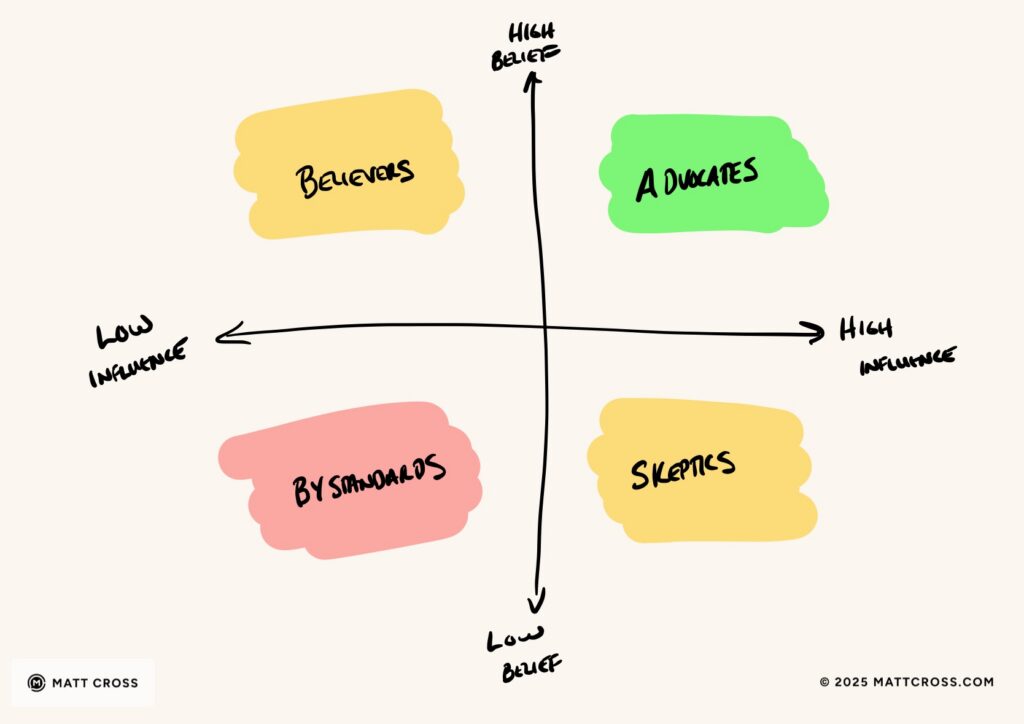
The horizontal axis is influence over the decision: high on the right, low on the left.
As you work through this activity, the following questions tend to be helpful:
- Who has formal say in the decision?
- Whose opinion will the decision-maker ask for informally, even without an official role?
- Who has already been asked about you or your idea, without your knowing?
- Who inside your function has a view that travels upward?
- Which peers or outside counterparts would be consulted as a reference point?
- Who loses something if this succeeds?
That last question is the one people are most tempted to skip, and it’s often the one that matters most. Support isn’t only a question of who’s excited. It’s also a question of who’s threatened, and pretending that person isn’t in the room doesn’t make them go away.
Once the grid is filled in, the picture usually gets a lot clearer than it was five minutes earlier. High belief, high influence people are your advocates, the ones you lean on. Low belief, high influence people are a conversation you need to have before the meeting, not during it. And the people with real influence who are still uncertain are where nearly all of your energy belongs.
A Subtle Shift
Here is the shift I want to leave you with, and it is really simple.
Stop pitching your idea before you know who’s with you. Start mapping the room before you ever open your mouth.
That’s the shift, and it isn’t complicated. It simply requires you to sit down with a blank page before your next big ask and do the unglamorous work of finding out where people actually stand, instead of assuming you already know.
My client left that session with a plan instead of a hope. She knew who needed a real conversation before the meeting, who just needed a quiet preview, and who she could genuinely count on to carry the idea forward without her in the room.
Her ideas were never the problem. She just needed to know, before she asked for anything, whether she had the support to make them real.