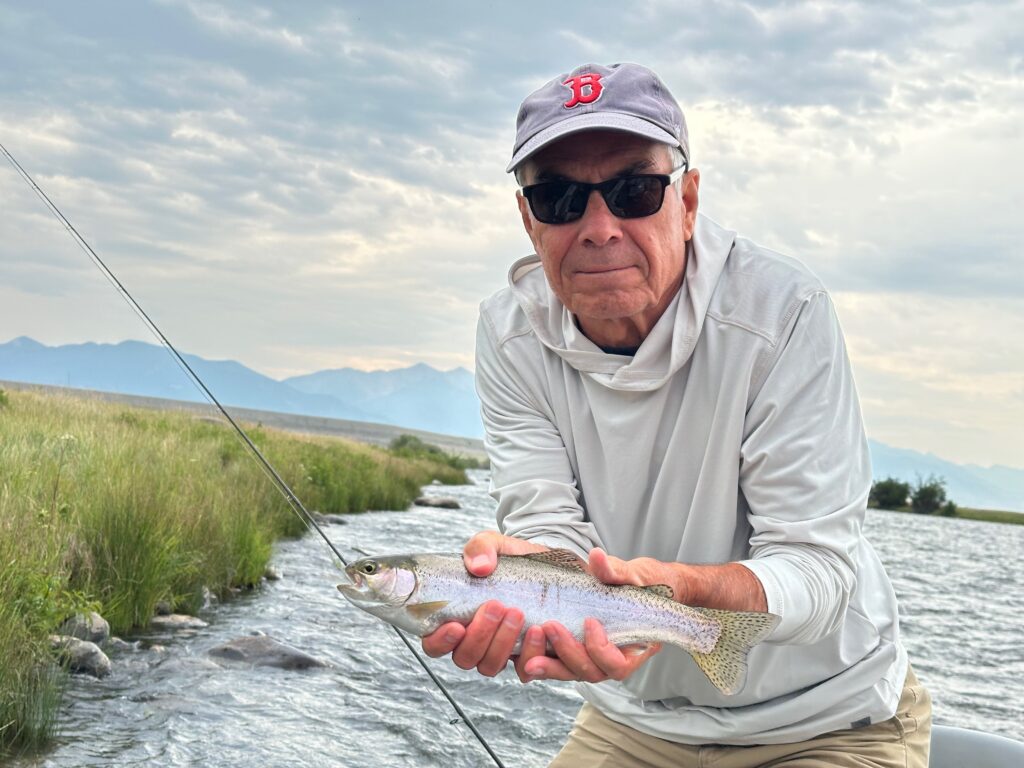
Last week I went fly fishing with my dad on the Madison River in Ennis, Montana. It’s a fly fishing mecca. And if you’ve been watching The Madison starring Michelle Pfeiffer and Kurt Russell, that’s exactly where we were. We had such a great time out on the water, and it was so cool to spend time with my dad doing what he really loves. Check out this beautiful rainbow trout he caught.
After two days on the water, my mind was racing with ideas about how the things I was learning out on the water applied to life and leadership. Some of the connections were pretty out there, but watching my guide Harry read the river made me realize how important it is for us to appreciate the things other people can see that we can’t.
I think this is key to building trust in the workplace!
What a fly fishing guide taught me about trust
We fished with a guide named Harry Desmond from Berkshire Rivers Fly Fishing. As we floated down the river in his boat, I was amazed at how he read the water. He’d point and tell us exactly where to throw our flies. He knew where the fish would be based on the currents and the ripples. Now if you’ve ever fished the Madison, you know it’s a river of ripples. The water moves at a steady pace, and to an amateur like me, it all looked the same. But Harry sees so much more, because his mind is filled with distinctions he’s developed over thousands of hours on the water.
That word, distinctions, has stuck with me for years. A distinction is the ability to see a meaningful difference where everyone else sees sameness. I first learned the concept while attending Georgetown University’s Leadership Coaching program. One of our instructors drew a picture on the board and said, “This is a desert. If you were standing on this hill looking out over it, what would you see?” Almost everyone in the room said the obvious: sand.
Then he said, “The person standing next to you is a native of this land. He’s lived in the desert his whole life and hunted here to feed his family, just like generations before him. What do you think he sees?”
We sat there quietly, and he went on. “That person would see ripples in the sand telling him the wind was blowing from west to east. He’d notice a plant wilting in a particular way and know it hadn’t rained in several days. And he’d read the tracks of an animal and tell you when it passed by.“
In other words, we are all looking at the same desert, but a person with distinctions sees an entirely different world.
A few years later, I attended a retreat where one of the activities was learning how to blacksmith. Our instructor showed us how to make a simple hook, and he hammered it into shape in minutes. It was a beautiful piece of work, and watching him made it look so easy. Then we grabbed our own chunks of metal, heated them in the fire pit, and followed his seven-step process.
My hook looked nothing like his! It was so much harder than it looked.
Each of his steps hid dozens of subtle distinctions that were invisible to me. I didn’t know how hard he hammered, the angle he struck the steel, or the tension in his hand. I had no idea when to start hammering and when to stop. But because he was more aware of the distinctions than I was, he was able to apply nuance and knowledge and skill in a way that I couldn’t.
Why appreciating distinctions builds trust in the workplace
The psychologist Anders Ericsson spent his career studying how experts become experts. His research showed that what separates them isn’t raw talent. It’s thousands of hours of practice that change what they’re able to notice.
So here’s the leadership connection. You can’t know it all, and you can’t do it all. Running a successful organization means relying on people whose minds are filled with distinctions you don’t hold. Your controller, your engineer, your best salesperson… each of them is reading a river that you can’t read.
But here’s the problem. Distinctions are subtle, and often invisible. When Harry looked at the water, nothing about him looked different from my perspective. He would even explain what he was looking at, but I couldn’t see it!
The reason is simple.
Expertise doesn’t announce itself, so we look right past it. We tend to quietly assume that what looks easy must be easy. In my experience, that assumption is where trust in the workplace starts to erode.
This week’s subtle shift
Shift your assumption from “that looks easy” to “that took thousands of hours I never saw.”
Then act on it. Pick one person whose work you’ve been taking for granted and ask them to show you what they see. Ask your analyst what she notices in the numbers, or your foreman what he hears when a machine sounds wrong. Then tell them what you appreciate about it.
And while you’re at it, consider your own distinctions. What do you see that others can’t, and what distinctions do you want to spend the next thousand hours developing?
The people around you are reading rivers every day. Appreciating the distinctions they hold might be the fastest way to build trust in the workplace, and it costs you nothing but attention.
If this resonated, my book Subtle Shifts goes deeper on the power of attention, assumptions, and actions. Pick up a copy or share one with a friend. The book has the potential to change lives.