Reactive vs Proactive Leadership: Why Your State Matters More Than Your Substance
We spend a lot of time talking about what good leaders do. We talk about their strategies, tactics, actions, and achievements. All of that matters because substance matters, but that isn’t the only thing that makes them successful. In leadership, state matters as much as substance, and understanding the difference between reactive vs proactive leadership is one of the most important distinctions a manager can understand. But it’s almost never discussed in those terms.
Think about the last time you had a difficult conversation with someone on your team. Delivering feedback they didn’t want to hear, pushing back on a decision, trying to get alignment on something that kept going sideways. Now ask yourself what state you were actually in during that conversation. Were you calm, clear, and grounded? Or were you anxious, reactive, and quietly hoping it would end quickly?
Here’s what I know to be true: the same words, delivered from two different internal states, land completely differently. The substance was identical. The state changed everything.
Mapping Reactive vs Proactive Leadership
I’ve been working with a group of managers recently, and as we were getting started, we talked about what masteryin in leadership looks like. We talked about how mastery is really an internal state and consists of far more than skill or substance. Mastery is achieved when we rise to the top of this pyramid and start operating from a proactive, influential and impactful state.
Take a look at this pyramid to understand the different states:
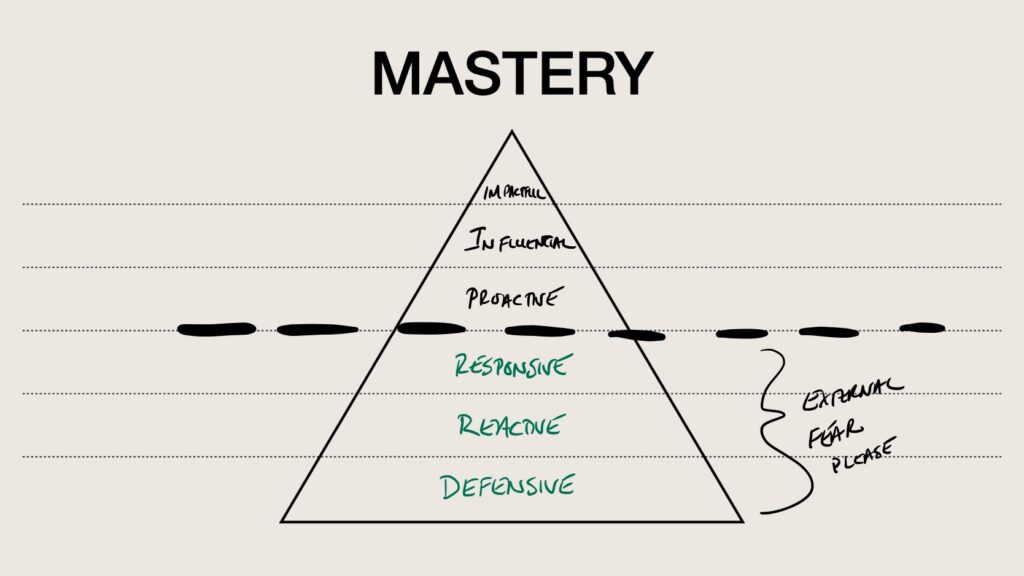
At the bottom sits the defensive state, where fear is driving the bus. You’re in protection mode, trying to protect yourself, your team, your reputation. Anxiety is high, awareness is low, and any energy that could go toward leading is going toward surviving instead.
Just above that is the reactive state, where most managers spend a significant portion of their careers. Things are flying at you constantly, and you’re spending your days putting out fires. An old professor of mine used to say his students were just tumbleweeds blowing in the wind, and when you’re in the reactive state, that description fits perfectly. You’re not leading so much as responding to whatever lands on your desk next.
Then there’s the responsive state, which is tricky because it looks fine on the outside. You’re meeting the moment, handling things, staying on top of your inbox. Corporate culture tends to glorify this kind of responsiveness, but the problem is you’re still being driven by external circumstances. You haven’t escaped the pull of the outside world yet.
Everything below the line shares the same root cause. It’s driven by fear, by pressure, by the need to please others or meet a standard set by someone else. And that is not leadership.
What Mastery Actually Looks Like
Proactive and highly effective leadership lives above the line, where you stop reacting to what’s happening around you and start creating the conditions you actually want. Where you walk into the hard conversation grounded rather than guarded. Where your state serves your substance rather than quietly working against it.
The managers I work with are talented people who know their craft and care deeply about their teams. But when their state is off, that talent doesn’t get through cleanly. A stressed manager delivers good feedback badly. A reactive manager makes decisions in ways that undermine confidence in them. An anxious manager can run a perfectly structured meeting right into the ground. The substance was never the problem.
The shift from reactive to proactive leadership doesn’t begin with a new skill set or a better system. It begins with awareness.
The Subtle Shift
Before you focus on what you’re going to say or do, check in on the state you’re bringing to it. Ask yourself whether you’re above the line or below it, whether you’re leading from intention or simply reacting to the moment.
Awareness alone won’t solve everything, but it is always the first step. You can’t lead well from a place you haven’t noticed you’re standing in.
Hit reply and tell me which state you’re in most often.